UniSim-SLAM: Feed-Forward SLAM with Unified Sim(3) Optimization

ECCV 2026

Inha Lee1, Dongjae Jeong1, Junhee Lee1, Kyungdon Joo1,†
1Ulsan National Institute of Science and Technology, Ulsan, Korea
Corresponding author
UniSim-SLAM applied to an image sequence captured with a mobile phone.

Abstract

Recent geometric foundation models enable feed-forward inference for SLAM, but their predictions are strongly dependent on the input view set, which leads to geometric inconsistencies and trajectory drift when results are chained over long sequences. Online deployment further exposes a trade-off between the low latency of two-view tracking and the constraint richness of multi-view inference.

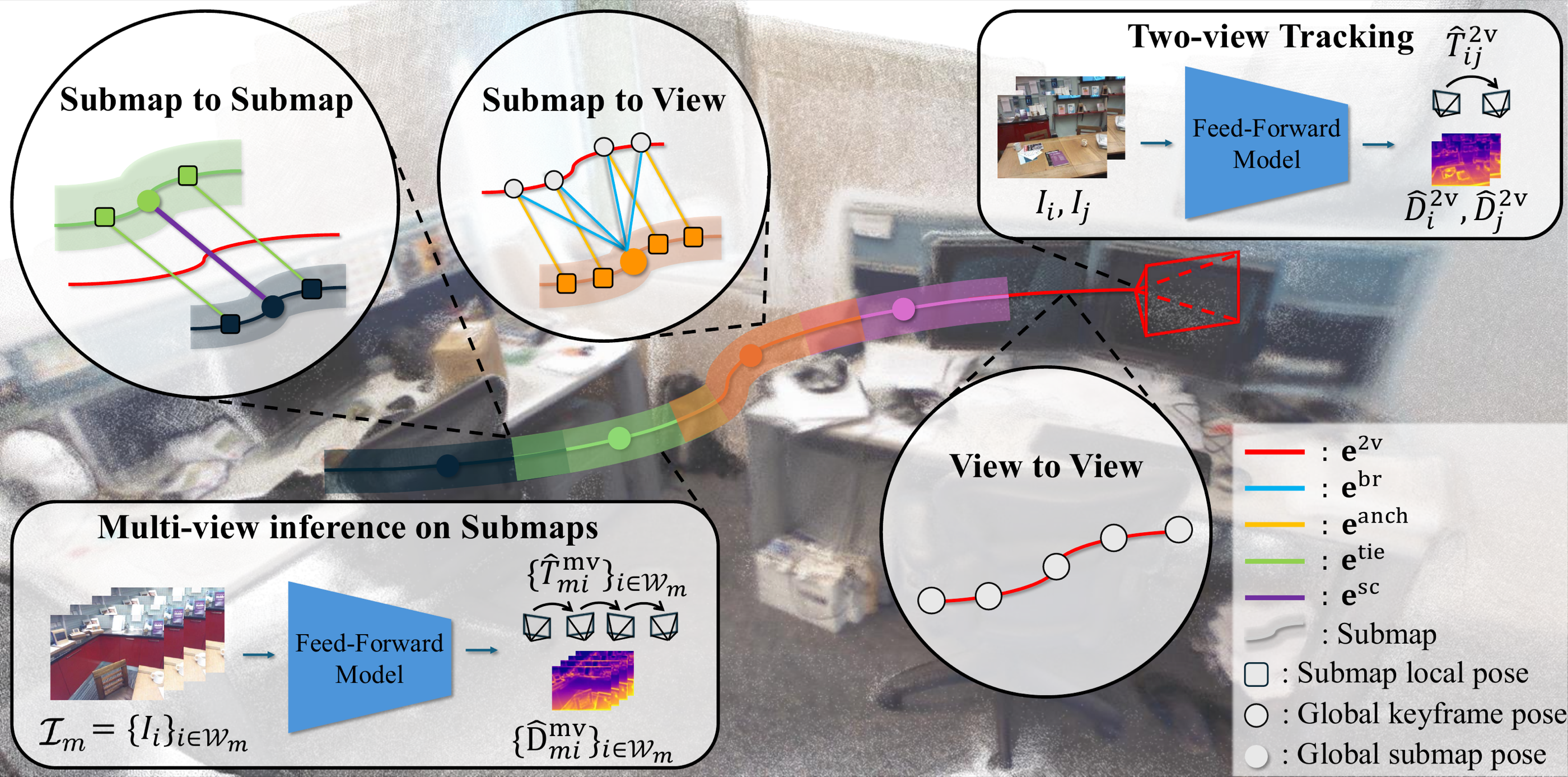
UniSim-SLAM runs lightweight two-view keyframe tracking in the frontend and performs periodic multi-view submap refinement in the backend. To combine predictions defined in heterogeneous local coordinates with inconsistent scales, it formulates a unified multi-level factor graph on Sim(3) that jointly optimizes global keyframe poses and submap poses.
Overview

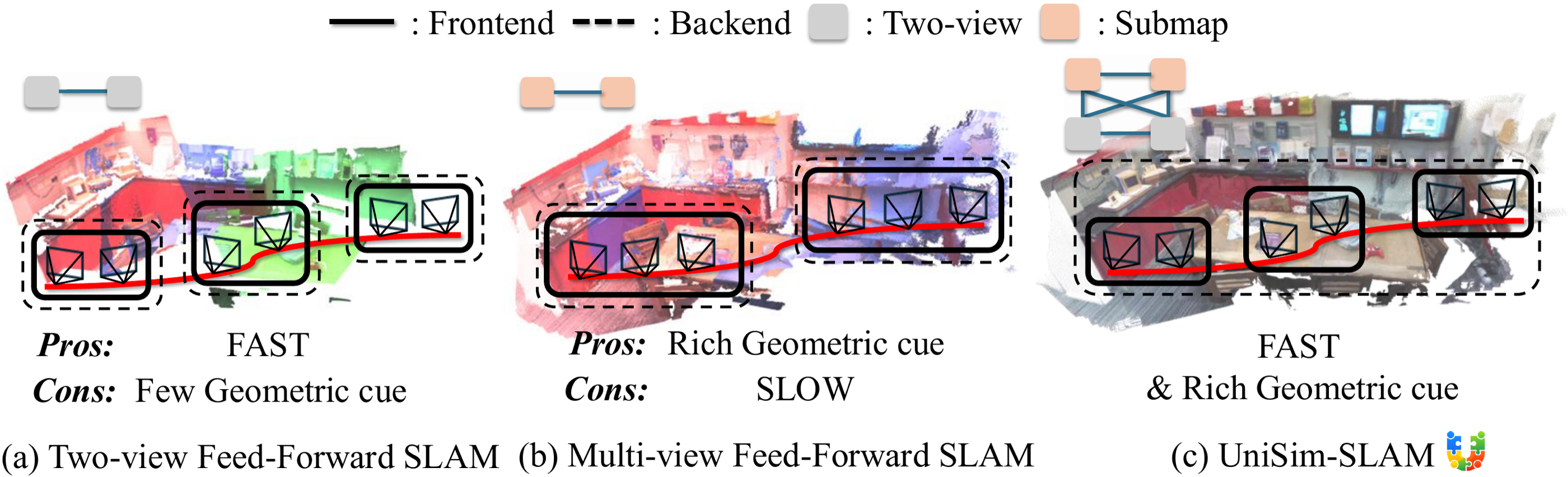
Comparison of two-view, multi-view, and UniSim-SLAM feed-forward SLAM regimes
UniSim-SLAM combines a low-latency two-view frontend with a constraint-rich multi-view submap backend, then jointly optimizes both in a unified Sim(3) factor graph.

The key idea is to treat two-view and multi-view feed-forward predictions as complementary constraints rather than isolated outputs. Temporal two-view edges preserve immediate tracking connectivity, while multi-view submaps provide richer geometric anchors for long-term consistency.

Overall Framework

Overall UniSim-SLAM framework
A feed-forward model produces two-view pose and depth for tracking and multi-view submap predictions for local geometry. UniSim-SLAM integrates these predictions into a unified Sim(3) factor graph.

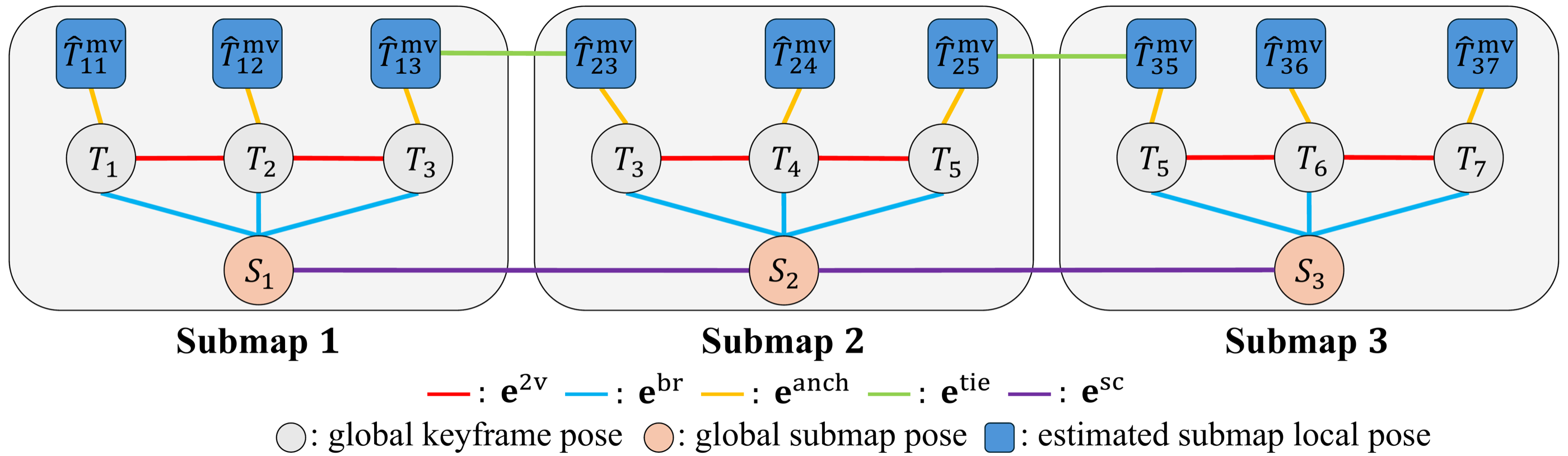
Multi-level Sim(3) Factor Graph

Multi-level Sim(3) factor graph representation
The graph connects frame-level and submap-level variables through view-to-view, submap-to-view, and submap-to-submap constraints, enabling scale-consistent optimization across heterogeneous local reconstructions.

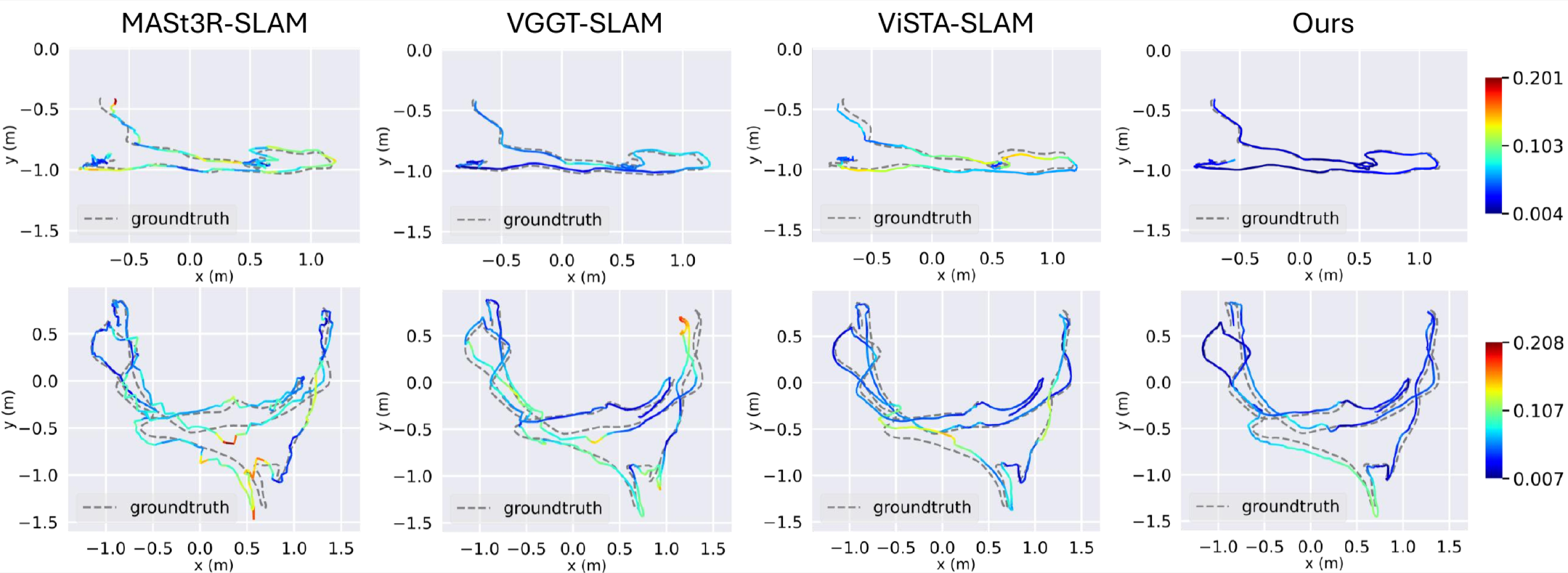
Qualitative Trajectory Results

Qualitative trajectory comparison on 7-Scenes
Qualitative trajectory comparisons on 7-Scenes show reduced drift and lower error under the unified optimization framework.

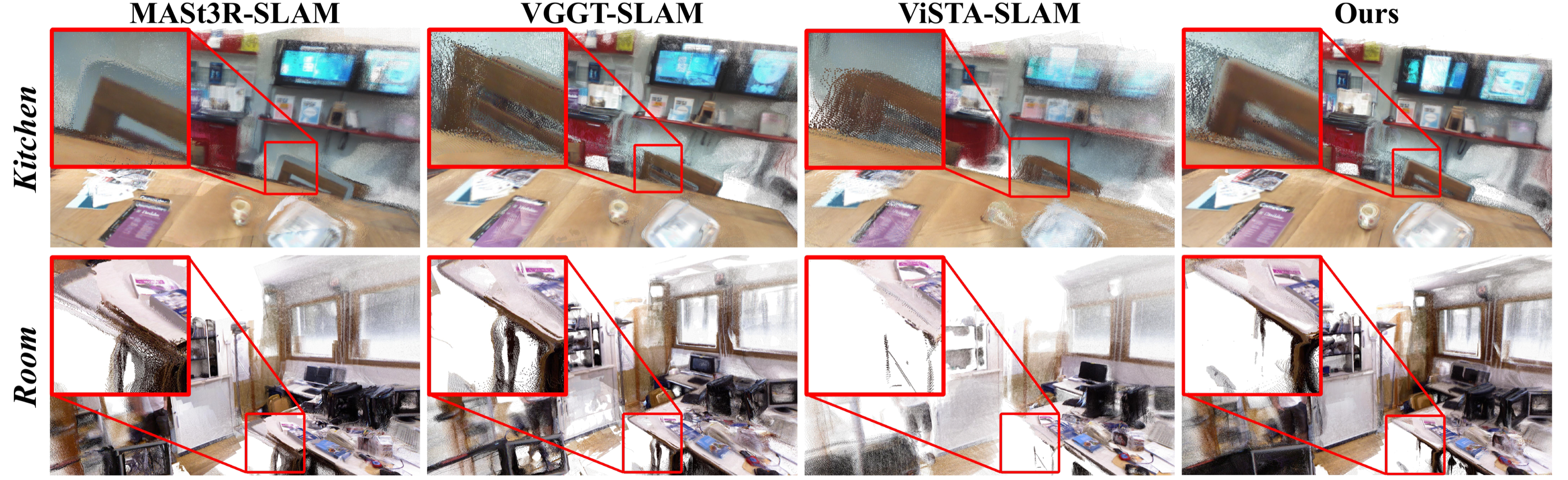
Reconstruction Results

Reconstruction comparison on 7-Scenes and TUM RGB-D
Reconstruction results on 7-Scenes and TUM RGB-D highlight the geometric consistency obtained by jointly optimizing two-view and submap constraints.

Citation

Publication pending. BibTeX will be added after the paper is public.