CVPRW 2026 · Single-Image Animatable Animal Reconstruction

AniGauss: Toward Animatable Animal Reconstruction from Single In-the-Wild Images via Topology-Aware Gaussians

A feed-forward framework that turns one casually captured animal image into a controllable, SMAL-aligned Gaussian avatar by first hallucinating canonical semantic views and then reconstructing topology-aware articulated Gaussians.

Gyeongsu Cho1, Changwoo Kang1, Donghyeon Soon3, Hezhen Hu2, Kyungdon Joo1
1UNIST · 2University of Texas at Austin · 3DGIST
Single in-the-wild image Canonical four-view generation SMAL topology prior Animatable Gaussians
AniGauss overview: canonical four-view generation followed by topology-aware animatable Gaussian reconstruction
Abstract

From one animal photo to an animatable avatar.

AniGauss addresses the under-constrained setting where the input is a single in-the-wild image but the output must remain both visually faithful and controllable.

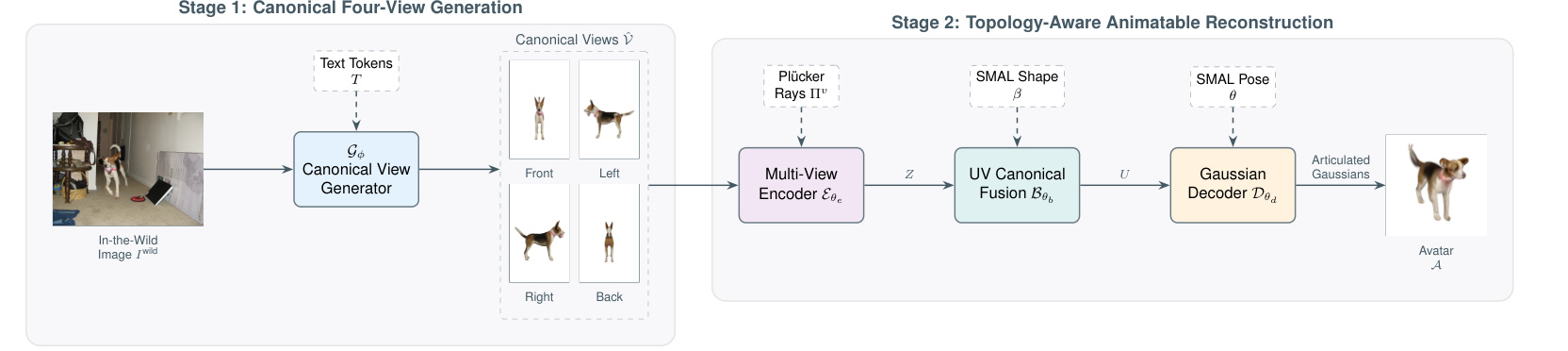
AniGauss decomposes single-image animatable animal reconstruction into two stages. First, a canonical four-view generation module predicts front, left, right, and back views of the same animal, exposing appearance cues missing from the original monocular observation. Second, a topology-aware reconstruction module fuses these ordered views in a UV-aligned canonical space and decodes a SMAL-aligned animatable Gaussian representation. By anchoring Gaussian primitives to an articulated animal topology, AniGauss preserves structural coherence while enabling pose-conditioned animation from a single in-the-wild image.
InputSingle in-the-wild image
CanonicalizationFront, left, right, back views
RepresentationSMAL-topology-aware Gaussians
OutputRe-posable animal avatar
Contributions

A two-stage route to controllable animal reconstruction.

View Prior

Canonical View Generator

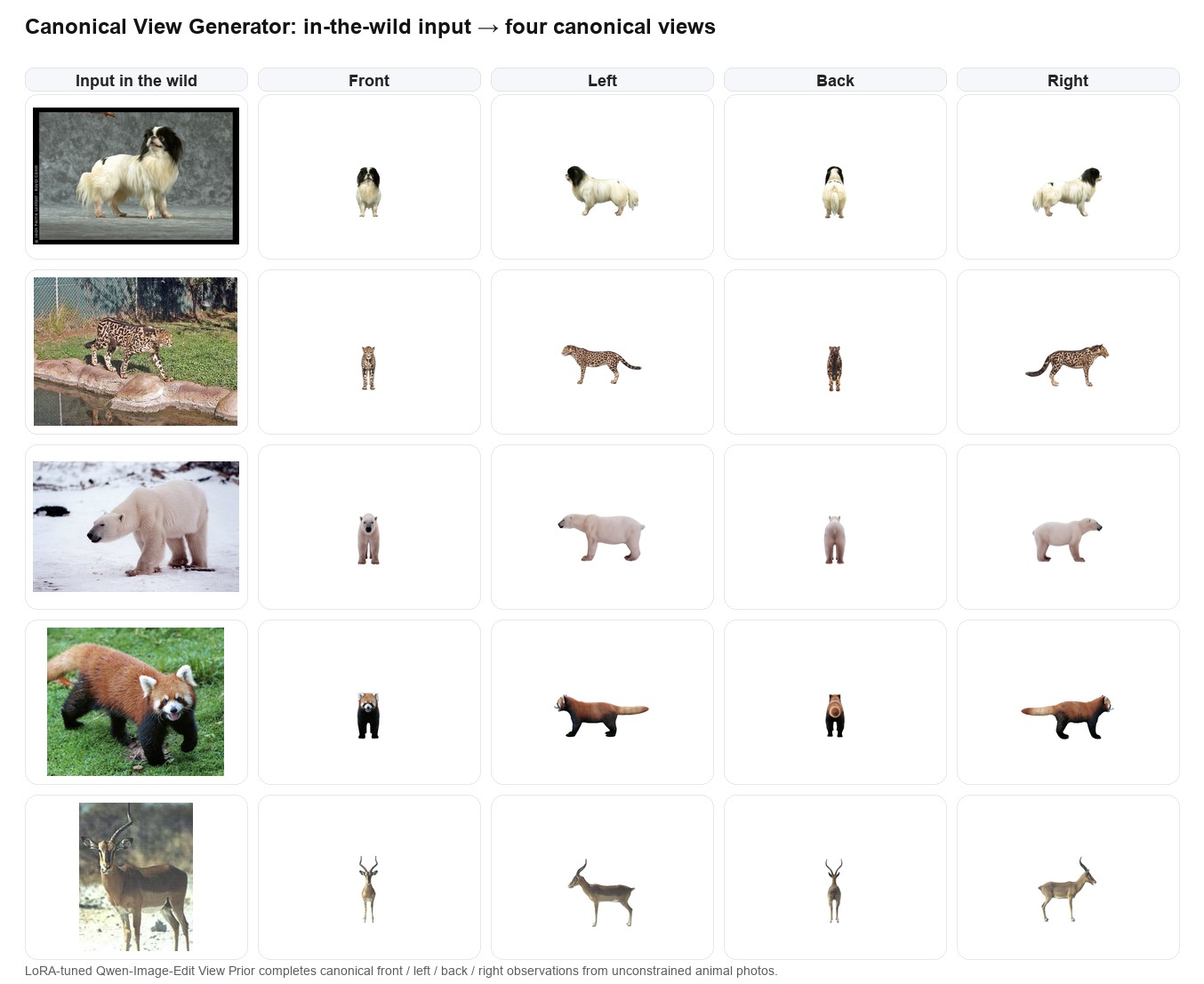
Adapts a large generative image prior into a canonical view generator that handles in-the-wild animal images and predicts front, left, back, and right views.

Representation

Topology-aware Gaussians

Anchors Gaussian primitives to the SMAL animal body prior so the reconstructed avatar remains structurally coherent and explicitly re-posable.

Supervision

AniGA10k-style synthetic data

Uses textured parametric animal assets with exact canonical-view and articulated 3D supervision to train the canonicalization and reconstruction pipeline.

Canonical View Generator

Using a Large Generative View Prior for In-the-Wild Inputs.

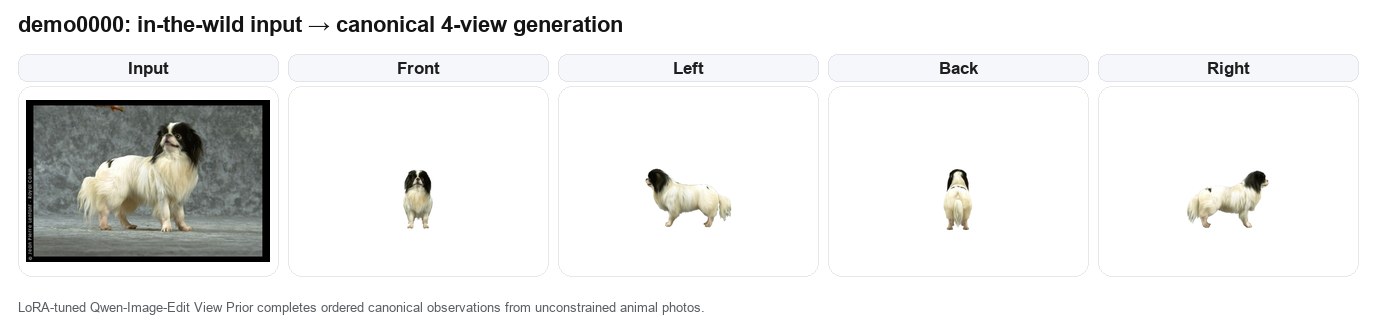
We LoRA-tune a large image-editing prior into a view-aware generator. Given one unconstrained animal photo, the generator completes a semantically ordered set of canonical observations — front, left, back, and right — which provides stronger appearance and geometry cues for feed-forward animatable reconstruction.

Method

Canonical views first, topology-aware reconstruction second.

The first stage reduces monocular viewpoint ambiguity. The second stage converts ordered multi-view appearance into an articulated Gaussian avatar.

AniGauss two-stage framework diagram

Pipeline overview. Given a single in-the-wild image, AniGauss predicts canonical semantic views and reconstructs an animatable animal avatar through multi-view encoding, UV canonical fusion, and SMAL-topology-anchored Gaussian decoding.

Canonical four-view generation

Instead of asking the reconstruction network to infer every unseen side from one observation, AniGauss first completes a semantically ordered set of canonical views: front, left, right, and back.

SMAL-topology-aware Gaussian decoding

The decoder predicts Gaussian attributes in a canonical animal space and articulates them through the underlying SMAL topology, enabling controllable pose-conditioned rendering.

Qualitative Results

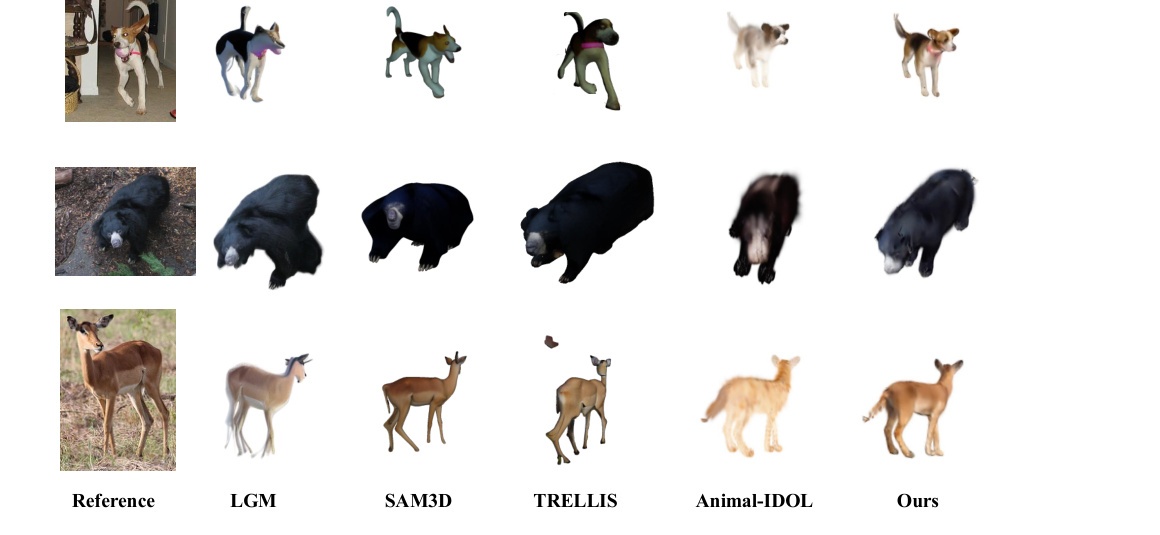
More animal-specific structure than generic image-to-3D baselines.

AniGauss is evaluated on challenging quadruped images with articulation variation, occlusion, and complex appearance patterns.

Qualitative comparison of AniGauss with LGM, SAM3D, TRELLIS, and Animal-IDOL on animal image-to-3D reconstruction
Demo

Feed-forward animatable reconstruction in the wild.

The demo shows that AniGauss can take an arbitrary in-the-wild animal image and reconstruct an animatable avatar in a feed-forward manner.

Original MOV: demo1_anigauss.mov

Poster

CVPRW poster.

The project poster summarizes the AniGauss pipeline, topology-aware Gaussian representation, and qualitative comparisons.

Future Work

Toward more advanced animatable animal reconstruction.

We plan to further improve AniGauss with stronger canonical-view generation, richer topology-aware Gaussian modeling, more diverse animal categories, and more robust handling of challenging in-the-wild cases such as occlusion, extreme articulation, fur, and fine geometric details.

Citation

BibTeX will be updated with camera-ready metadata.

@inproceedings{anigauss2026,
  title     = {AniGauss: Toward Animatable Animal Reconstruction from Single In-the-Wild Images via Topology-Aware Gaussians},
  author    = {Cho, Gyeongsu and Kang, Changwoo and Soon, Donghyeon and Hu, Hezhen and Joo, Kyungdon},
  booktitle = {CVPR Workshop},
  year      = {2026}
}